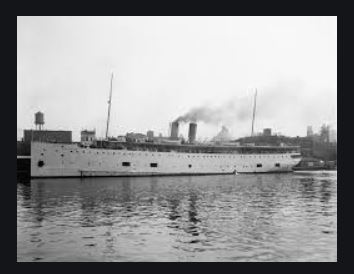
SS Eastland |
| The SS Eastland was a passenger ship based in Chicago and used for tours. On 24 July 1915, the ship rolled over onto her side while tied to a dock in the Chicago River. A total of 844 passengers and crew were killed in what was the largest loss of life from a single shipwreck on the Great Lakes. --Wikipedia |
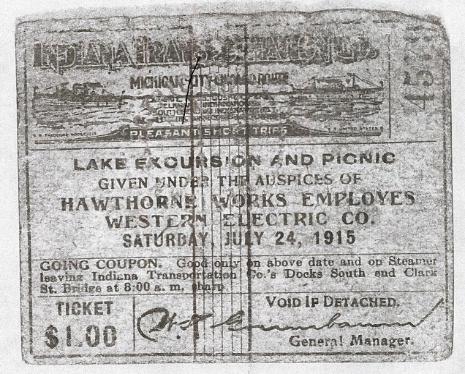
| The Eastland disaster On 24 July 1915, Eastland and four other Great Lakes passenger steamers, Theodore Roosevelt, Petoskey, Racine and Rochester, were chartered to take employees from Western Electric Company's Hawthorne Works in Cicero, Illinois to a picnic in Michigan City, Indiana.This was a major event in the lives of the workers, many of whom could not take holidays. Many of the passengers on Eastland were Czech immigrants from Cicero; of the Czech passengers, 220 perished. During 1915, the new federal Seamen's Act had been passed because of the RMS Titanic disaster three years earlier. The law required retrofitting of a complete set of lifeboats on Eastland, as on many other passenger vessels. This additional weight may have made Eastland more dangerous by making it even more top-heavy. Some argued that other Great Lakes ships would suffer from the same problem. Nonetheless, it was signed into law by President Woodrow Wilson. Eastland was already so top-heavy that it had special restrictions concerning the number of passengers that could be carried. Prior to that, during June 1914, Eastland had again changed ownership, this time bought by the St. Joseph and Chicago Steamship Company, with Captain Harry Pedersen appointed the ship's master. Postcard of the Eastland and Pederson; postmarked 24 July,1915 On the morning of 24 July, passengers began boarding Eastland on the south bank of the Chicago River between Clark and LaSalle Streets about 6:30 am, and by 7:10 am, the ship had reached its capacity of 2,572 passengers. The ship was packed, with many passengers standing on the open upper decks, and began to list slightly to the port side (away from the wharf). The crew attempted to stabilize the ship by admitting water to its ballast tanks, but to little avail. Sometime during the next 15 minutes, a number of passengers rushed to the port side, and at 7:28 am, Eastland lurched sharply to port, and then rolled completely onto its port side, coming to rest on the river bottom, which was only 20 feet (6.1 m) below the surface; barely half the vessel was submerged. Many other passengers had already moved below decks on this relatively cool and damp morning to warm before the departure. Consequently, hundreds of people were trapped inside by the water and the sudden rollover; some were crushed by heavy furniture, including pianos, bookcases, and tables. Although the ship was only 20 feet (6.1 meters) from the wharf, and in spite of the quick response by the crew of a nearby vessel, Kenosha, which came alongside the hull to allow those stranded on the capsized vessel to leap to safety, a total of 844 passengers and four crew members died in the disaster. The bodies of the victims were taken to various temporary morgues established in the area for identification; by afternoon, the remaining unidentified bodies were consolidated in the Armory of the 2nd Regiment,[7] on the site which was later transformed into Harpo Studios, but has since been demolished to make room for a new McDonald's corporation headquarters. In the aftermath, the Western Electric Company provided $100,000 to relief and recovery efforts of family members of the victims of the disaster. |
One of those who perished aboard the Eastland was Joseph Betlach, 18 year old son of Frank and Katie Kodek Betlach |

 | |  |